
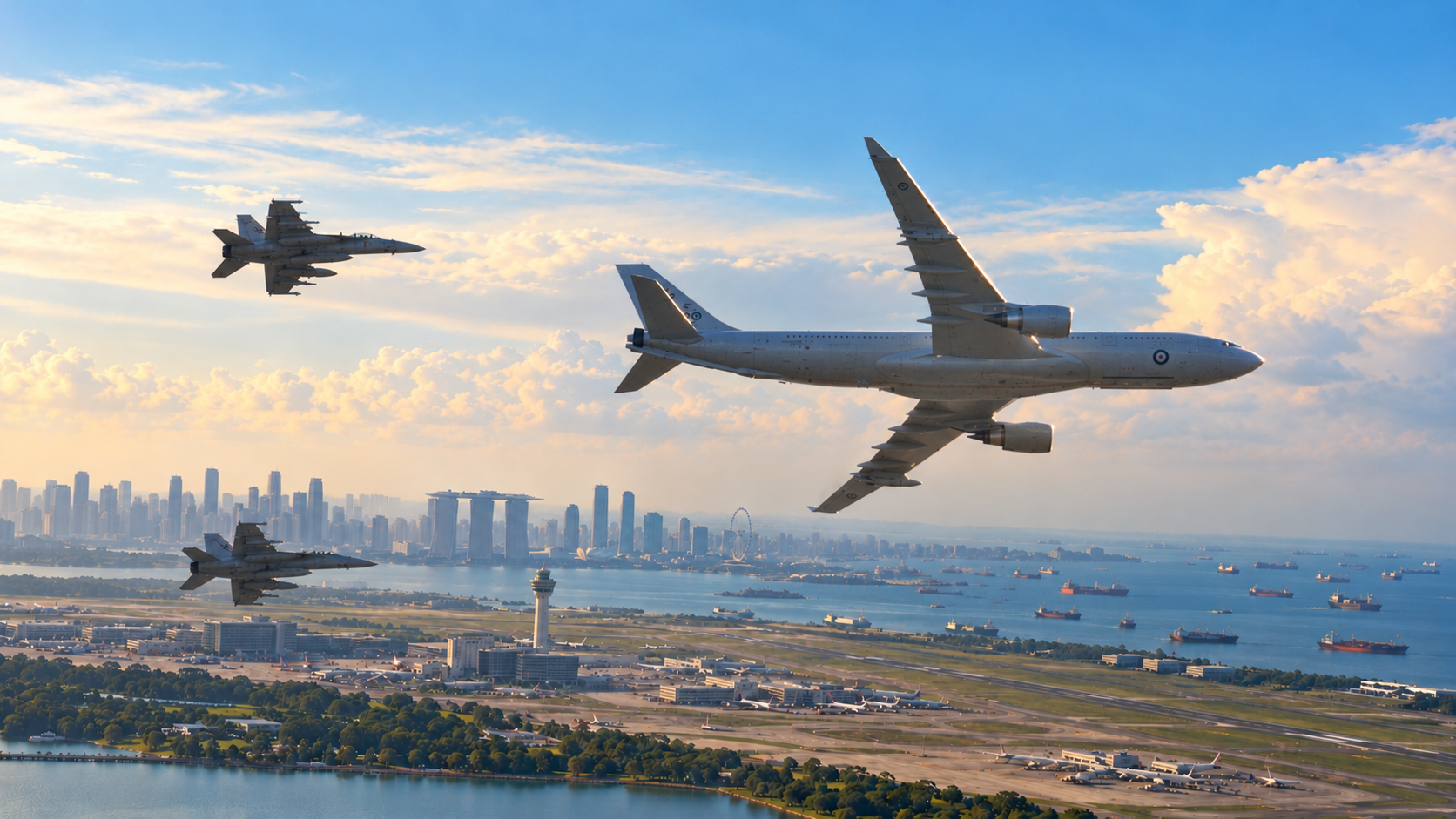
Intercepted Over Singapore: What Happens When Your Aircraft Violates Singapore Airspace
A pilot’s aircraft was escorted in by two F-16s. Here’s the legal terrain that follows an airspace violation — and how defence actually works.
For most pilots, the worst inflight emergency is mechanical. For a small number, it’s looking out of the cockpit window and finding two fighter jets off the wingtip. An intrusion into controlled airspace without clearance — whether from navigation error, communication failure, misfiled flight plans, or something less innocent — triggers
Singapore&’s air defence response: interceptors scrambled, the aircraft shadowed and escorted, and the radio exchange that follows conducted under international interception signals while everyone on the ground decides what happens when you land.
Our firm has stood at the point where this stops being an aviation incident and
becomes a legal one. We defended an Australian pilot whose aircraft was intercepted by two F-16s after an intrusion into Singapore airspace — guiding him through the regulatory and enforcement aftermath that follows such an incident. That case is the reason this article exists: pilots, operators and owners facing airspace enforcement action almost never understand what’s coming, and the difference between a disciplined defence and an improvised one is measured in licences, livelihoods, and liberty.
What actually triggers an interception
An aircraft may be intercepted when it enters sovereign airspace without authorisation, deviates materially from its cleared route, fails to respond to air traffic control, or is otherwise assessed as a security concern. Singapore, a densely packed sovereign airspace adjacent to major international airways, treats unauthorised entry with full seriousness — the interception is the visible part; the radar, command and decision architecture behind it is the invisible part.
For the pilot, the immediate reality is procedural: follow ICAO interception signals — rocking wings, switching to a discrete radio frequency, following the interceptor, complying with instructions — while recognising that everything transmitted is recorded and everything done will be examined afterward.
The legal aftermath: three tracks that can run simultaneously
Once on the ground, an airspace violation typically unfolds across three distinct legal tracks — and confusing them is the most common mistake made by pilots and even their advisors.
Track one: regulatory enforcement. Aviation regulators investigate breaches of the Air Navigation Act and associated orders — flight without clearance, deviation from clearance, communication failures. Sanctions can range from warnings to fines to suspension or revocation of licences. For a professional pilot, the licence is the career: regulatory defence is livelihood defence.
Track two: criminal exposure. Depending on the facts and how the matter is characterised, airspace violations can attract criminal investigation and prosecution — ranging from regulatory offences to, in aggravated scenarios, more serious charges. Where criminal exposure exists, nothing said in the administrative process is automatically protected from the criminal one. Sequence matters, and silence
rights matter.
Track three: diplomatic and employment fallout. A foreign pilot (as our client was) faces an additional layer: immigration status, employer notification, insurer notification duties, and — depending on the aircraft’s registry and operator’s State — questions that cross borders with the pilot. Employment contracts for flight crew frequently contain termination triggers tied precisely to enforcement events, sometimes before any finding of guilt.
How defence in these cases actually works
Defending an airspace violation is fact intensive reconstruction. The core questions our team pursues:
- The flight plan and clearance chain — what was filed, what was issued, what was acknowledged. Ambiguities here frequently migrate from violationto misunderstanding.
- Communications logs — every transmission between the aircraft and every controller who worked it. Radio failure and instruction ambiguity are defences with real force when the tapes support them.
- Navigation data — GPS tracks, FMS routing, and where the aircraft actually went versus where it was cleared to go. The geometry of the deviation often decides the characterisation of the event.
- The human factors — fatigue, cockpit workload, equipment unfamiliarity, language. Not excuses; context that regulators and courts weigh when calibrating outcome.
- Proportionality of the response — enforcement authorities have discretions, and advocacy exists at every decision point: charge or not, which charge, what sanction, what conditions.
In our client’s case, disciplined engagement with each layer — the regulatory record, the enforcement characterisation, and the pilot’s position as a foreign professional in Singapore — defined the defence. The outcome is now part of the public record. Reporting on the defence in its 29 October 2026 feature on the firm, The Straits Times wrote that in one high-profile case in 2008, [Salem Ibrahim] defended the pilot involved in an airspace intrusion incident over Singapore skies that triggered two Republic of Singapore Air Force F-16 fighter jets to intercept the Cessna 208 aircraft, resulting in a 50-minute shutdown of all commercial air traffic at Changi Airport — and that he successfully defended the pilot’s operational exposure, resulting in a $5,000 fine imposed by the court, with no jail time. (The Straits Times, print edition, 29 October 2026, page A22.)
Why owners and operators should care, not just pilots
If the aircraft is registered to a company, leased, or operated commercially, the violation attaches consequences beyond the person at the controls: insurers, charter clients, and the operator’s certificates can all be touched. An aircraft owner facing an incident involving their aircraft needs counsel who can speak both languages — aviation regulation and commercial protection — before statements are made that bind the company.
The pilot’s first 48 hours: a practical checklist
Say nothing substantive before advice — cooperate with immediate safety directions, but treat interviews as formal proceedings, because they are
Preserve everything — flight plans, clearance records, notes, personal devices with routing apps; the memory of the flight is being reconstructed by everyone else from logs, and yours is the only first-person account
Notify insurers where policies require it, but take advice on the wording of notifications
Engage counsel who knows aviation from the inside — aviation enforcement is a specialism, and general criminal practice without regulatory fluency (or vice versa) leaves half the board uncovered
Our standing
Salem Ibrahim LLC defends pilots, owners and operators in aviation enforcement matters, including the defence of the Australian pilot intercepted by two F-16s over Singapore airspace. The firm earned the only five-star rating in Aviation, Aerospace and Space Law — ranking No. 1 in the category — in The Straits Times/Statista Singapore’s Best Law Firms 2027 survey, on more than 12,000 recommendations from almost 6,000 lawyers. Three areas overall received five stars: Aviation, Aerospace and Space Law; Alternative Dispute Resolution (ADR); and Family Law.
The firm’s aviation practice spans the full spectrum — from multi-jurisdictional jet transactions and aircraft registration to aviation disputes and offences — led by Salem Ibrahim, a lawyer with 38 years’ experience, has held a pilot’s licence for decades and has shepherded business aviation transactions and disputes for over 28 years.
We understand airspace enforcement from both ends: the regulatory machinery, and the cockpit.
A pilot, aircraft or operator facing enforcement action after an airspace incident? Early, confidential advice changes outcomes — call (65) 6226 1233.